
The Nadi Readers

( Nadi Reader in Old Delhi)
The man who performed my reading is holding the Nadi leaves on the table
My translator ( for English to Tamil and Tamil to English) is on the right
“The will is not free, it is a phenomenon bound by cause and effect-
but there is something behind the will which is free.”
- Swami Vivekananda
This is how it felt . . .
Imagine if you traveled to a far away and ancient city
and while wondering there you hear of a secret library,
unlike any other on earth
and you are given directions and go there
and it takes a long time
and the streets you travel are busy and crowded
filled with people and cars
and the long-sought street the library is on,
is non-descript
and does not stand out in any way
and you go up the steps
and at the second story upstairs flat
there is an unremarkable door
and
you remember the restaurant you ate at once
where you lifted a bowl of soup to drink
on a delightful night of nothing special
and saw the most amazingly wondrous sight:
an orange chandelier glowing in the bowl you held
then looking deeper, you see yourself,
with a different face
living a different life
with different parents
and friends
wearing exotic clothes
and
you look into the eyes of the one whom you see looking back at you
and pass through the bright doorway of the here and now
into a shabby room with faded paint
and dirty walls and windows
where a dark-skinned man with a red bindi mark on his forehead
and bright white shining teeth is singing in ancient Tamil
reading off a tiny script no more than 1/8” high
inscribed long ago in Sanskrit on a palm leaf
now bound between two strips of wood
and what he is reading is all about 'you.'
Recently, only several thousand years ago,
at the direction of a Chola King, this very text
you are now hearing
was originally written down in Sanskrit
and then many years later
translated into ancient Tamil, the South Indian language
The writing was etched in black ink on a palm leaf
which has passed through the more recent ancient dynasties
that ruled India:
the Cholas, the Muslims, Vijayanagar, the Portuguese, the Mughals,
the Dutch, the French and finally the British
who last and ignorantly burned and destroyed much of the library
and auctioned off the rest.
(It is now thought that over 60% of the library has been destroyed)
and
the brown-skinned man singing before you is singing
to you about your life
reading the etchings on a palm leaf
that were first recited by a Rishi
who had overheard a conversation between Lord Shiva
and his consort Parvati . . .
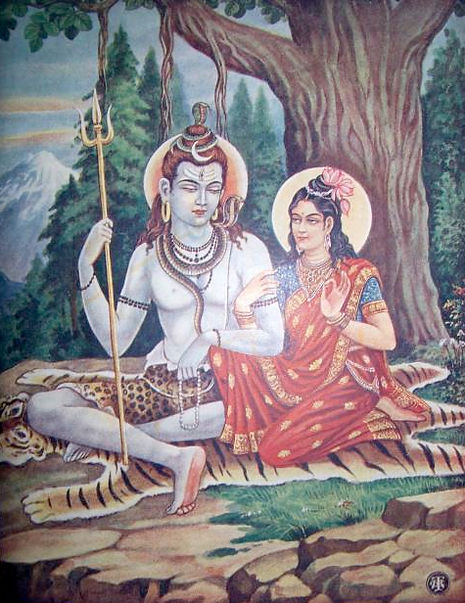
It was a conversation in which Parvati asked Shiva
to recite the fate of her children,
which Lord Shiva then does
taking a long, long time to do so
and when I heard the story of my own life
sung and read out
starting with the names of my own parents,
Norman and Marjorie,
that they are deceased,
that I have an older brother from your Father's first wife
and that my partner's name is 'Gilda'
my mind is stunned with wonder
and I believe I could be Parvati's child . . .
If you understood what is being said
or what is going on here,
then ‘you’
will no longer exist
and
‘you’
will pass through a bright doorway into the here and now
where you are sitting in a shabby room and there are children playing outside
and you are hearing about your own life
written in a palm leaf book thousands of years ago
and stored in a temple in South India
The 'book' is written on rectangularly cut palm leaves
(about 1/16" x 2" x 20")
with two cords holding together the pages
bound between two 3/16" wooden boards
The Palm Leaf manuscript
has been pulled down from dusty, old, wondrous stacks
of that ancient library
especially for you
based only on your thumbprint
It is a book that holds
several pages written about
‘you’
as you are right now, this moment, today,
your history, how you came to be here
what you did in your past life
what you will do in your future life
and somehow this book
or the writer of this book
knew that you would come to this library
to hear this text read out to you today!
right now . . . !
it is your Nadi
or destiny!
and the chandelier glows in the soup bowl
turns blue and sparkles and brightens into a white brilliance
it seems that someone has light
and that someone knows ‘you’
where ‘you’ have been
what ‘you’ have done
who you have met
and what will happen to ‘you’ in the future
'You' hear that this leaf or book was spoken and written
thousands of years ago by someone you never met
by someone, your parents never met
by someone, your partner never met
who knew the day you were born
the month and the time
and knew that 'you' would come today
this day, this week, this year, this life
and this book would be waiting for 'you'
everything entering into this single moment
all together
like the reflection of the moon that night
with your dear friend Anthony
on a still country lake in summer,
when the universe peeled back it's blanket of stars
and the incredible blessing of it
full of peace and wonder
poured out over the lake
and swept ‘you’ both away.
the 'you' that was then
and now
and never
When the Buddha became enlightened under the Bodhi tree,
he remembered all his past lives.
He looked into life as one would look at a mirror
and he saw . . .
Imagine what it is like for a person to live without such a mirror
to never see oneself
to never have a memory of who 'you' are
'You' and 'I'
is this person
And,
this palm-leaf book in this ancient library
is a mirror of who 'you' and 'I'
is, are
have been
and will be
To understand this is a great mystery
It is to see who arranged the petals on a flower
and as they are so incredibly perfect and wondrous
but you have seen them . . .
you became a poor artist or a monk or a renunciate
or a parent or a thief
You are saint and sinner
lover and hater
perhaps you cared for someone
so much
that you cried
and felt the pain
of not getting what you want
and after much time had come and gone
and the water of many lifetimes
had flowed beneath that bridge
you
became thankful for the pain
and for all that you have been given
and
for in spite of all that is
it is always forever
taken away from us
and with tears
you give up
and
dissolve utterly
This has happened before
it is happening now
it will happen again
I am reminded of a dream that Carl Jung relates
in his autobiography: Memories Dreams and Reflections
"I was walking along a little road through a hilly landscape;
the sun was shining and I had a wide view in all directions.
Then I came to a small wayside chapel.
The door was ajar, and I went in.
To my surprise, there was no image of the virgin on the altar,
and no crucifix either,
but only a wonderful flower arrangement.
But then I saw on the floor sat a yogi- in lotus posture,
in deep meditation.
When I looked at him more closely,
I realized he had my face.
I started in profound fright and awoke with the thought:
“Aha, so he is the one who is meditating me.
He has a dream, and I am it”
I knew that when he awakened I would no longer be."
This is the hole in the universe and if it is true,
and it seems to me that it is,
then what is going on is a great mystery
it has been going on for a long, long time.
Having the Nadi readers find my leaf
is the most amazing 'thing' that I experienced in India.
The biggest slap across the face of free will I ever received.
It should change my life
It should change all our lives


The pictures above are of Nadi readers outside of Kanchipuram in Tamil Nadu.
They are a father and son. After my experience in Old Delhi, where they found my leaf
I wanted to visit other Nadi Readers to see if they, too, could find my leaf.
Although they looked, they were not able to find it.
They were, however, glad to share with me about the Nadi tradition
and their understanding and practice of it.
The Nadi readers who did find my leaf,
including my Father's name and my Mother's name and middle name
were in Old Delhi
(You can see their picture at the top of the page)
Struck with the accuracy and life-changing implications
of what the Delhi readers
had told me, I decided to visit South India
and go to the Saraswati Mandir temple in Thanjavur and
visit the main temple, where most of the Nadi leaves are still kept
in an ancient library.
On the way, I visited several other Nadi readers in Tamil Nadu
to see if they could also find my leaf.
None of them did.
I never made it to Thanjavur.
On my way there, I traveled through the south of India
to the state of Tamil Nadu, where
I stayed on the beach at Mamallapuram
next to the Shore Temple
where the oldest temple in all of South India is built.
While I was there, on the morning of
December 26, 2004, the Tsunami hit.
It changed my 'plans' for the time being.
I still hope to find out more about the Nadi tradition that has so much to say,
about how life works and the law of karma.
The Nadi readings are a slap in the face of free will . . .
How could I have used my free will if all of what they told me was true
(and it certainly seemed to be, at least about this life)
and it was written down over a thousand years ago?
The Indian tradition believes 100% in fate or destiny born of karma
and 100% in free will.
This does not make 'sense,'
and they know it . . .
neither does an endless universe
(India tends to put more emphasis on fate.
The tendency in the West is to put more emphasis on free will)
Both of these are considered to be the 'true' principles of life
and together, they offer a stunning dilemma.
If the Nadi readings are genuine, it seems that most of us
do not use our free will very much.
I certainly had not.
How could my mother's name and middle name be known and written down
a thousand years ago?
They (the Nadi readers) could not have read my mind
and then written it down on the palm leaf
I was in the room the whole time.
I was allowed to take a picture of my leaf and had it independently translated.
It was written in ancient Tamil, similar to Latin in modern-day English.
They were not reading my mind.
It seems that what and who we think we are, we are not.
Almost all of what we think is free will is fate.
I was told that while the readings are considered to be very accurate
up to the present (parabdha karma).
As to the future, they accept free will, the effect of present actions, and understanding
which can be changed by the Nadi readings
as well as any other action (agama karma and kriyamani karma).
Some people will say, "I do not believe in such things. I do not believe in Astrology."
I reply, 'Have you ever studied the field? Have you ever looked into it?
Have you ever had a reading?'
I would say that if anyone explores it,
not the short, superficial readings that you can find
in the daily paper or a magazine,
but,
a full Jyotish reading performed by a competent Vedic astrologer
you will find that Vedic Astrology and what it tells you is impossible to dismiss
Water is wet and fire will burn, this is not a matter of belief, but, of direct experience.
Belief and doubt are both irrelevant.
Even so, all children need to test the flame with their finger
and
Just so, you must test astrology yourself.
If we know the seed
we can know the tree, what its fruits will be
as well as the 'parents' of the seed.
According to the same principle
it is possible, by an 'examination' of any present moment, to see the future and the past
Astrology does not simplify the world or one's life.
On the contrary, by throwing light (Jyoti) upon the qualities, processes, and events of life,
it makes them even more mysterious.
Life is a cloth woven warp and woof from karma . . .
We call it 'cause and effect'.
The 'cause' is the effect concealed
The 'effect' is the cause revealed
It is incomprehensible
and
worthy of wonder
I will close by explaining how I began this article.
A mysterious saying from the Indian tradition by one of its most extraordinary men.
Because such a thing as the Nadi leaves is true and because it was known
to the greatest men of the ancient Indian tradition, they could say:
“The will is not free-it is a phenomenon bound by cause and effect-
but there is something behind the will which is free.”
-Swami Vivekananda
My Nadi reading was the most amazing thing I encountered in India
Update 2018
Several friends have visited the Nadi readers in Old Delhi and recently have been asked for what I think to be significant amounts of money: "48,000rs (about $500usd) so priests could do puja for the next 240 days of nonstop chanting to remedy his karmas." My friends passed on the donation and still received the readings; it is now six years later (2024)
When I went in 2004, there was an optional donation of 500rs.
The readings were still outstanding and 'mind-blowing.'
So, be warned and do what you think is best. Do not volunteer any information about your birth date, name of parents or siblings, etc. If they ask you, 'Does your father's name begin with a 'N,' and it is true, simply say, 'Yes.' Otherwise, you will not believe it if they find your leaf. Like things all over the world, especially in India, along with inexplicable phenomena that are true, there are a lot of fakes and scams, so I suggest you keep to these few simple suggestions.

Above: (picture of a nadi leaf)
For more articles about the Nadi on the web:
For Related Stories and Articles by Peter Malakoff:
Tragedy Fate and Nemesis- A consideration of fate and free will
This essay and stories within it, consider the relationship between the loss of the sense of tragedy and the rise of 'New Age' thinking.
Stories of DH Lawrence, Carl Jung, Isak Dinesen, Agamemnon, Oedipus, Nemesis, Darius, Tyche Polycrates, Eisenhower and Gandhi are all brought together here.
A short piece on the ancient metaphor of' the seed and the soil'.
This metaphor provides a fundamental paradox for any consideration of free will and the environment or factors other than 'I' or 'us'.
The word for character in ancient Greek was ethos, from which we get our word "ethics."
Heraklitos, writing at the dawn of Western philosophy,
held that a person's 'ethos' is their daimon, or fate
- "Ethos anthropos daimon"
A man's character is his fate
"And never say of anything, 'I shall do such and such thing tomorrow.
Except (with the saying): "INSHALLAH" ('God willing).
A look at the Islamic idea of fate and free will, with the ancient Islamic story,
"An Appointment in Samarra" as told by Somerset Maughm, set to music.